

How Do You Create a Winning AI Product Naming Strategy That Builds Trust?


Most enterprise AI deals don’t stall at the demo stage. They stall much earlier—when someone first hears the product name and quietly doubts it.
That moment is easy to miss. A name that feels vague, overhyped, or too “techy” creates hesitation before your product even gets evaluated. And in enterprise environments, hesitation slows everything—internal alignment, approvals, and ultimately adoption.
This is why an AI product naming strategy is not a branding afterthought. It’s an early trust signal. It shapes how seriously your product is taken in the first conversation itself.
In a market flooded with “AI-powered” claims, your name does one critical job: it tells buyers whether you understand their world or whether you’re just another tool trying to sound intelligent.
Get it right, and your product enters the conversation with credibility. Get it wrong, and you spend the rest of the cycle trying to rebuild trust that should have been there from the start.
What Is An AI Product Naming Strategy And Why It Matters
An AI product naming strategy is the structured approach you use to define how your AI product is named, positioned, and understood in the market.
It goes beyond creativity. It answers a few critical questions:
- What does this product actually do?
- Who is it for?
- How should people feel about using it?
- Where does it sit in your broader AI brand identity?
When this is unclear, naming becomes inconsistent. You end up with products that sound impressive but feel disconnected. That confusion shows up in demos, sales conversations, and even internal adoption.
But when the naming is clear, something shifts. People “get it” faster. Conversations move quicker. And trust builds earlier in the journey.
Why Most AI Product Names Fail To Build Trust
Before fixing the process, it helps to see what usually goes wrong. Most AI brand naming decisions fall into one of these traps.
First, they lean too heavily on hype. Words like "genius," "brain," and “hyper-intelligence” sound impressive but rarely explain anything meaningful. They signal ambition, not clarity.
Second, they become overly technical. Names filled with model references, acronyms, or internal jargon may make sense to product teams but not to buyers or users.
Third, they ignore the human side. AI adoption is not just technical. It is emotional. People need to feel safe using it. A name that sounds opaque or intimidating slows that down.
And finally, there is inconsistency. Many companies name products in isolation instead of within a larger AI brand identity. This leads to a fragmented portfolio that feels hard to navigate.
Read more insights: AI Adoption Challenges
AI Product Naming Strategy Must Align With Your AI Brand Architecture
This is where naming stops being isolated.
Every AI product exists inside a broader system. And without structure, that system becomes fragmented.
A well-defined naming architecture ensures every product name fits into a coherent portfolio, reinforcing both identity and usability . This is why naming decisions should be anchored in your AI Brand Architecture, not treated as standalone branding exercises.
When this alignment is missing, even strong products feel disconnected. Users cannot understand how different tools relate. And trust weakens.
AI Product Naming Strategy That Builds Trust Starts With Clarity
1. Define The Job Your Product Does
Every strong AI product naming strategy begins with clarity around function. What real-world problem does your product solve?
Avoid describing the technology. Focus on the outcome. For example, “automated insights generation” is clearer than “multi-layer neural analytics engine”.
When the job is clear, naming becomes easier and more grounded.
2. Understand The Adoption Context and Narratives
Where and how will your product be used?
A tool built for internal analysts can carry more specificity. A product aimed at cross-functional teams needs simpler, more intuitive naming.
In enterprise settings, names must travel across departments. Finance, marketing, operations, and leadership should all be able to understand it without translation.
Also, a product name becomes meaningful only when it fits into a larger story.
This is where your AI Strategic Narrative matters. It defines how the product is positioned, how it is explained, and how it connects to broader business outcomes.
Without that narrative, even a good name feels incomplete.
3. Map The Emotional Signal
Trust is not built through logic alone. Ask yourself what the name should signal:
Should it feel dependable? Assistive? Precise? Transparent?
Words carry tone. And in AI, tone matters. A name that feels stable and supportive tends to outperform one that feels experimental or aggressive.
Building A Practical AI Naming Framework
A strong AI naming framework keeps your naming decisions consistent as your product portfolio grows.
.png)
Think of it as a system rather than a one-time exercise.
Layer 1: Descriptive Core
Start with a clear, descriptive base. This anchors the product in reality.
For example, words like “Insights”, “Assist”, “Predict”, “Flow” signal function without overcomplicating things.
This layer ensures immediate comprehension.
Layer 2: Brand Alignment
Next, align the name with your broader AI brand identity.
If your brand is positioned around trust and reliability, the naming should reflect that. If your brand is more exploratory and cutting-edge, the tone can shift accordingly.
This is where consistency matters. Names should feel like they belong to the same family.
Layer 3: Distinction And Recall
Once clarity and alignment are in place, add distinctiveness.
This could come from structure, phrasing, or subtle uniqueness. But avoid forcing creativity at the cost of meaning.
The goal is simple: easy to remember, easy to say, easy to explain.
How To Create An AI Product Naming Strategy That Scales
1. Avoid Naming In Isolation
One of the biggest mistakes in product naming for AI startups is treating each product as a separate branding exercise.
This works in the early days. But as your product suite grows, inconsistency becomes a problem.
Instead, define a naming system upfront. Decide how categories, features, and future products will be named. This reduces rework and keeps your portfolio coherent.
2. Test For Real Conversations
A name might look good on paper but fail in real usage.
Test it in simple scenarios:
- How does it sound in a sales pitch?
- Can a customer explain it to someone else?
- Does it create more questions or fewer?
If people struggle to use the name naturally, it needs refinement.
3. Balance Simplicity With Depth
Simple names work. But oversimplification can strip meaning.
The best AI brand naming balances both. It should be simple enough to understand quickly, but rich enough to carry meaning over time.
The Role Of Language In AI Brand Naming
Language shapes perception.
In AI, certain patterns are emerging:
- Neutral, grounded language tends to build more trust than exaggerated claims.
- Functional words outperform abstract ones in enterprise contexts.
- Short, clear names travel better across teams and markets.
But there is no single formula.
Your AI naming framework should reflect your product’s role, your audience, and your long-term positioning.
AI Product Naming Strategy And Enterprise Adoption
Here is where naming becomes directly tied to business outcomes. In enterprise environments, AI adoption is not just about capability. It is about clarity and confidence.
A strong AI product naming strategy helps in three ways:
- It reduces friction in onboarding. People understand what the product does without long explanations.
- It improves internal alignment. Teams use consistent language, which speeds up collaboration.
- It strengthens external positioning. Buyers feel more confident engaging with a product they can understand.
This is where naming moves from marketing into strategy.
Good to Read: Branding Strategy for Enterprise AI Application
How AI Product Naming Strategy Impacts Market Engagement
A name does more than describe.
It shapes how your product enters conversations.
And in AI, where differentiation is narrowing, that entry point matters more. A clear naming system supports stronger AI Market Engagement because it makes your product easier to position, explain, and remember.
This affects:
- How quickly buyers understand value
- How easily sales teams communicate
- How clearly your product stands out
And most importantly, how confidently people engage with it.
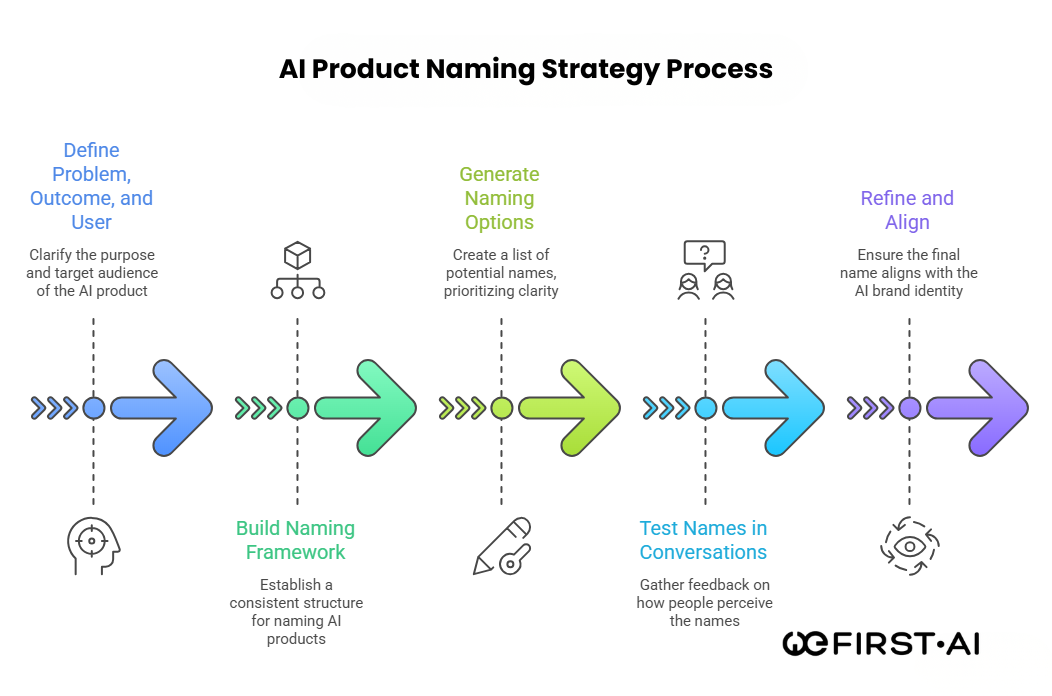
A Simple Process To Build Your AI Product Naming Strategy
If you need a practical way to approach this, keep it simple.
- Start with clarity. Define the problem, the outcome, and the user.
- Build your AI naming framework. Decide how names will be structured across products.
- Generate options within that system. Focus on clarity first, creativity second.
- Test names in real conversations. Listen to how people respond.
- Refine and align. Ensure the final name fits your broader AI brand identity.
This process is not complex. But it requires discipline.
The Link Between Naming And AI Brand Identity
Your naming strategy does not exist in isolation.
It is a visible layer of your AI brand identity. When done right, it reinforces your positioning. It tells a consistent story across products. And it helps your brand feel more coherent and credible.
When done poorly, it creates fragmentation. Even strong products can feel disconnected.
This is why naming should be treated as part of a larger strategic system, not a one-off task.
Common Mistakes To Avoid In AI Naming
Even with a framework, a few pitfalls show up repeatedly.
- Overloading the name with meaning. Trying to capture everything in one phrase often leads to confusion.
- Chasing trends. Just because certain naming styles are popular does not mean they fit your product.
- Ignoring scalability. A name that works for one product may not extend well to a broader portfolio.
- Forgetting global usability. Names should be easy to pronounce and understand across regions.
Each of these weakens trust over time.
What Winning AI Product Naming Looks Like In Practice
You can usually recognise a strong name instantly.
It feels clear without being basic. It signals function without over-explaining. It aligns with the brand without forcing it. And most importantly, it feels easy to trust.
There is no magic formula. But there is a pattern. Clarity first. Consistency second. Distinction third.
In that order.
Why This Matters More As AI Becomes Ubiquitous
As AI becomes embedded in more products, differentiation becomes harder.
Features can be replicated. Capabilities evolve quickly. But clarity and trust are harder to replicate.
A strong AI product naming strategy becomes a long-term advantage. It helps your product stand out not just because of what it does but because of how easily people understand and adopt it.
And in crowded markets, that difference matters more than most teams realise.
Final Thought
Naming has long been regarded as an artistic process. However, in AI, it's a trust decision. The right name for a product opens up possibilities for greater understanding; increases acceptance of the product; and supports the growth and development of the product.
In enterprise environments that can be the difference between the product being explored and the product being permanently integrated.
FAQs
1. What is an AI product naming strategy?
An AI product naming strategy is a structured approach to naming AI products in a way that clearly communicates their function, builds trust, and aligns with the overall brand. It ensures consistency and scalability across a product portfolio.
2. How does AI brand naming impact adoption?
Clear AI brand naming reduces confusion and helps users quickly understand what the product does. This speeds up decision-making, improves onboarding, and increases internal and external adoption.
3. What makes a strong AI naming framework?
A strong AI naming framework combines clarity, consistency, and scalability. It defines how products are named, ensures alignment with brand identity, and allows future products to fit naturally within the system.
4. Why do many AI product names fail?
Many AI product names fail because they are too vague, overly technical, or driven by hype. These names create confusion and reduce trust, making it harder for users to adopt the product.
5. How can AI startups approach product naming?
For product naming for AI startups, the focus should be on clarity and scalability. Start with a simple naming system, align it with your brand identity, and ensure names are easy to understand and extend as the product grows.
6. Should AI product names be descriptive or creative?
They should balance both. Descriptive elements build understanding, while creative elements improve recall. However, clarity should always come first in an AI product naming strategy.
7. How does naming connect to AI brand identity?
Naming is a core part of AI brand identity. It shapes how products are perceived, ensures consistency across offerings, and reinforces the overall positioning of the brand in the market.
Colleen Anderson is Marketing Head at We First AI, specializing in AI strategy, brand positioning, and market engagement. She helps organizations turn complex AI innovation into clear, trusted, and impactful business narratives.
Related Articles





NO PROMPT REQUIRED.
JUST REACH OUT.

